





We designed Materials Matter for All with sustainability in mind, aligning NDE, ESU 8, and NeMTSS Region 3 to embed professional learning on HQIM implementation for students with disabilities into ongoing support systems for educators.
This isn’t just about a successful pilot. It’s about building the infrastructure for lasting change.

In our previous posts, we described the challenge of helping students with disabilities benefit from high-quality instructional materials and our approach to scaling curriculum-specific professional learning across Nebraska.
Now, the critical question: How do we ensure this work continues after the pilot ends?
Too often, promising initiatives fade when grant funding ends or when external facilitators move on. We designed Materials Matter for All to avoid that outcome.
Sustainability was built into the project from the beginning. This pilot brings together:
- Nebraska Department of Education: State leadership and strategic direction
- ESU 8: Regional professional learning and district support
- NeMTSS Region 3: Multi-tiered systems of support infrastructure
Megan Dufek (ESU 8), Brooke Gebers, and Gray Morris (NeMTSS Region 3) aren’t just pilot participants; they’re leaders already embedded in the systems that support Nebraska educators. As they observe and co-facilitate alongside SPED Strategies, they are building the expertise to run this professional learning independently for other districts in their region. Because the training centers on how to use embedded supports with high-quality instructional materials, that knowledge travels, equipping them to help teachers get more out of the materials already in their hands.
Our goal isn’t just a successful pilot. It’s creating sustainable systems that ensure all Nebraska students, including students with disabilities, receive the support they deserve to access grade-level content through quality curriculum materials.
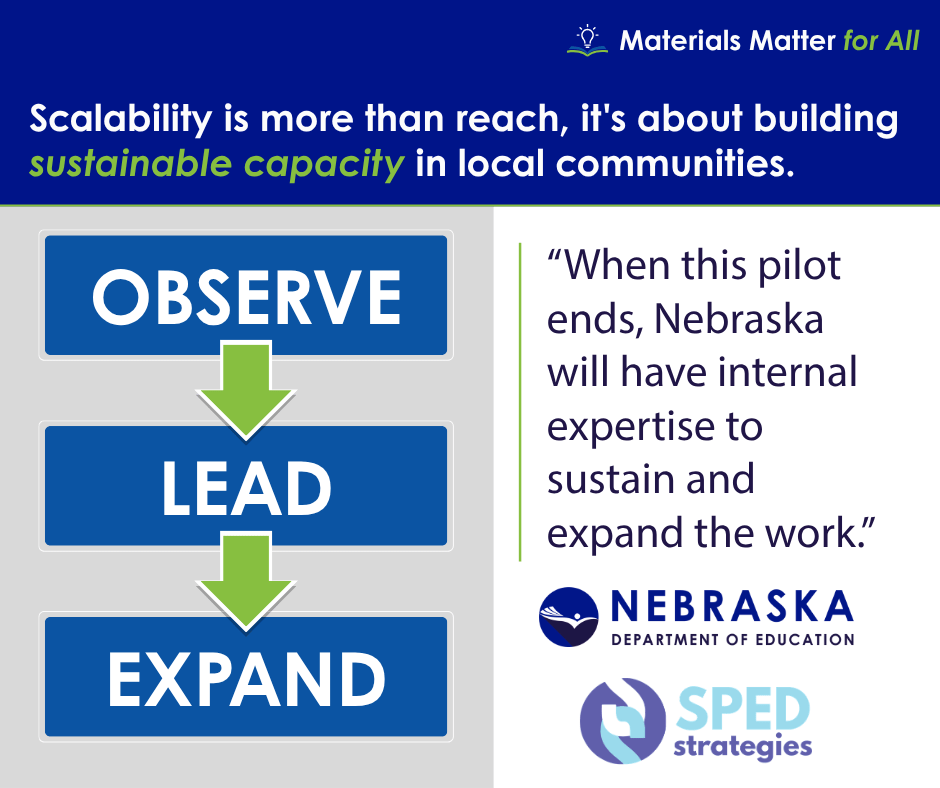
In our CCSSO Materials Matter for All pilot, SPEDStrategies facilitates curriculum-specific professional learning while Megan Dufek (ESU 8 MTSS & PEaK Coordinator), Brooke Gebers (NeMTSS Regional Support Lead), and Gray Morris (NeMTSS Integrated Support Specialist) observe and then lead parallel sessions with an additional cohort.
This approach ensures that when the pilot ends, Nebraska has internal expertise to sustain and expand the work. Follow along as we share what we learn!
In our first post, we described the challenge: students with disabilities weren’t experiencing the same gains from high-quality instructional materials as their general education peers.
Now, the next question: How do we bring targeted, curriculum-based support to educators across Nebraska’s geographically diverse landscape?
Nebraska spans 77,000 square miles. One-size-fits-all professional learning doesn’t work.
We needed a solution that could scale while building internal capacity for ongoing, localized support.
The Materials Matter for All pilot doesn’t create a new system. Instead, it builds on Nebraska’s existing support structures: ESUs and NeMTSS.
We partnered with Megan Dufek from ESU 8 and Brooke Gebers and Gray Morris from NeMTSS Region 3, leaders already trusted and embedded in the communities they serve.
This approach ensures that local leaders develop deep expertise in curriculum-specific professional learning for students with disabilities that they can use in tandem with their deep understanding of their community to support districts after the pilot ends. With the success of this model, we plan to expand the program to an additional ESU/MTSS region in the next year.
In our final post, we’ll explore how collaboration between state agencies, ESUs, and NeMTSS creates sustainable systems for supporting educators and students.
The challenge was clear: 80% of Nebraska districts had adopted high-quality instructional materials, but students with disabilities weren’t yet experiencing the same academic gains as their peers.
We knew quality curriculum materials mattered. But alone, they aren’t enough. Educators need guidance on how to use embedded supports effectively for students with disabilities.
That’s why we applied for, and received, a CCSSO grant to pilot an initiative focused on CBPL for students with disabilities. Materials Matter for All is a curriculum-based professional learning series in partnership with ESU 8, NeMTSS Region 3, and SPEDStrategies, where we are testing proven strategies for using HQIM for SwDs. Follow along as we share what we learn!

In recent years, Nebraska has made significant strides in adopting high-quality instructional materials. Today, 80% of our districts use research-backed curricula, a dramatic increase from just 5% a few years ago. But adoption alone doesn’t guarantee equitable outcomes.
Despite having access to the same high-quality materials as their peers, students with disabilities in Nebraska continue to perform significantly below grade-level expectations on state assessments. This isn’t a Nebraska-specific problem; it’s a national challenge. And it requires a targeted solution.
High-quality instructional materials include embedded supports designed to help all students access grade-level content. But educators need professional learning that shows them how to use those supports effectively, in the context of their own classroom.
That’s why we pursued funding from the Council of Chief State School Officers (CCSSO). CCSSO invited members of the High-Quality Instructional Materials and Professional Development Network to apply for funding to advance strategies that increase the use of high-quality instructional materials for students with disabilities. We received the grant, and the result is an initiative that blends existing focus areas for our state: the Materials Matter, Nebraska Literacy Project, and Journey to Inclusion.
Materials Matter for All is a pilot project designed to test curriculum-based professional learning for both general and special educators. In partnership with ESU 8, NeMTSS Region 3, and SPED Strategies, we’re facilitating a three-part training series that uses two of the most commonly applied curricula in the region: Amplify CKLA (grades K-2) and HMH Into Reading (grades 4-5).
Participating districts from ESU 8 committed to three full-day sessions between January and April 2026, plus surveys that help us measure impact on teacher mindsets and instructional practices, including:
- Changes in mindset about students with disabilities accessing grade-level content
- Increases in high-leverage instructional behaviors, including the use of embedded supports and collaboration between general and special educators
In our next post, we’ll share how we’re approaching scalability and how to bring this support to educators across a geographically diverse state.
"How I knew this was the state to show what inclusion can do" - Hechinger Report Article 1
"This state is rethinking how we teach kids with disabilities - and seeing promising results" - Hechinger Report Article 2
Nebraska made national news recently when The Hechinger Report, a nonprofit, independent news organization focused on innovation in education. You may read two of the articles from the report by selecting the images above to access the corresponding articles. We encourage you to take a closer look at what is happening in Nebraska, as we are rethinking the traditional approach to special education and seeing promising, measurable results.
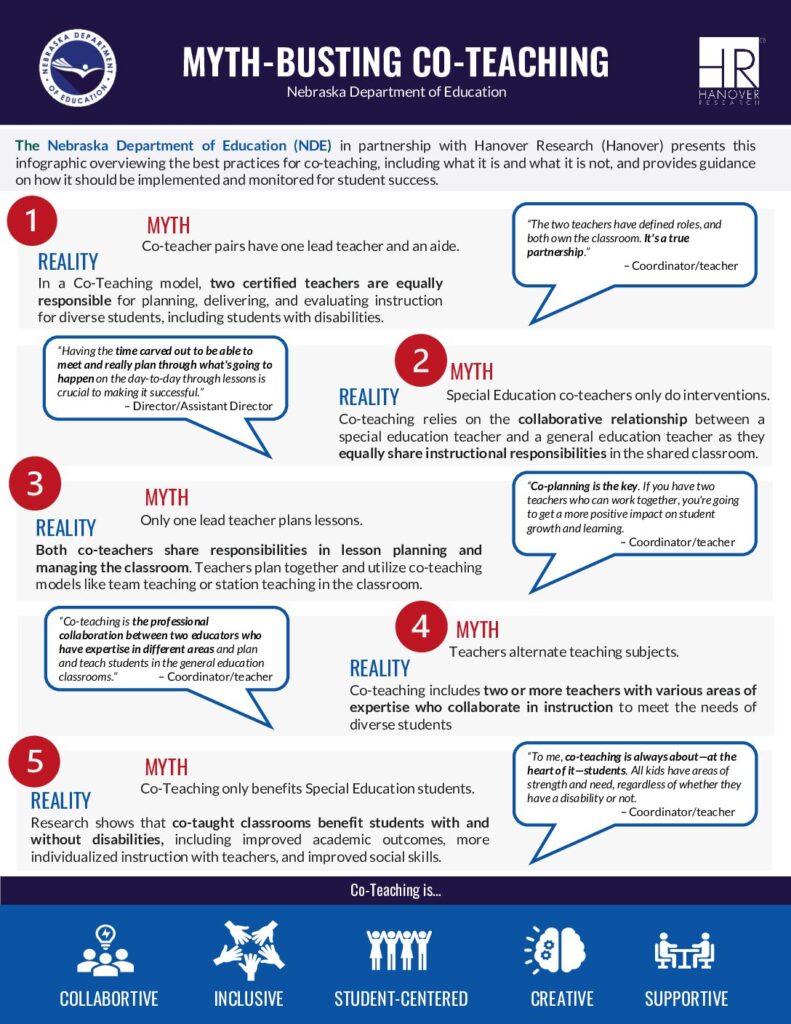
The Nebraska Department of Education (NDE) in partnership with Hanover Research (Hanover) presents this infographic overviewing the best practices for co-teaching, including what it is and what it is not, and provides guidance on how it should be implemented and monitored for student success.
Upcoming SPED Events
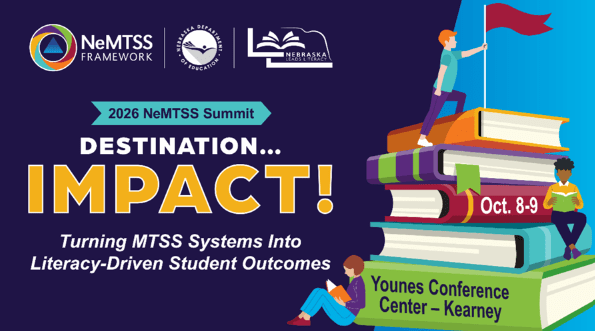
2026 Nebraska MTSS Summit – Hybrid
“Destination IMPACT – Turning MTSS Systems Into Literacy-Driven Student Outcomes”
October 8-9, 2025
Younes Conference Center North
Kearney, Nebraska
Participants may attend in person at the Younes Conference Center North or participate virtually.