

Nebraska Arts Education Standards
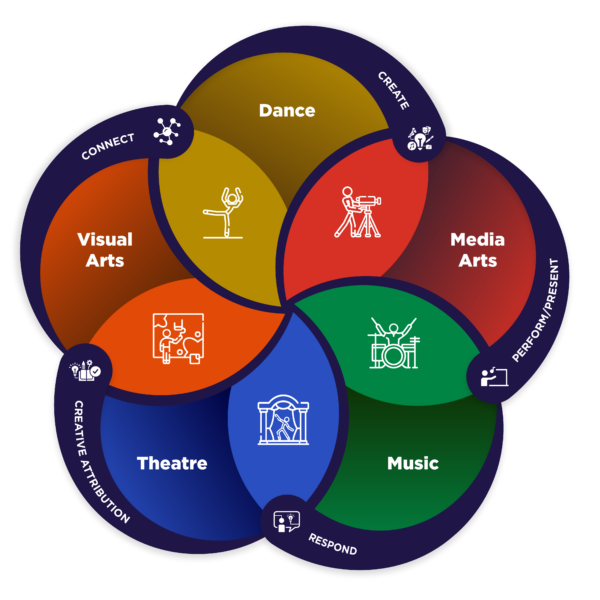
Arts education, or education in dance, media arts, music, theatre, and visual arts, contributes to a child’s growth and development and has the capacity to enhance overall well-being. The arts provide powerful and essential means of communication, encompassing unique symbols and ways of conveying meaning. Comprehensive arts learning allows children to discover and develop their own creativity. Arts and arts education offer valuable modes of self-expression, as well as insights into students’ unique cultures. The study of the arts promotes understanding and empathy as children consider the personal, social, cultural, and historical contexts of others. Finally, the arts help children collaborate and connect with others as they create and prepare works or participate in the sharing of artistic works.
The Nebraska Department of Education uses a collaborative writing process that utilizes the expertise of Nebraska educators and includes representation from all stages of Nebraska’s education system (i.e., early childhood education, K-12 education, and postsecondary education). The current Nebraska Arts Education Standards completed a revision in 2026 after their original adoption by the Nebraska State Board of Education in 2014.
2026 Arts Education Standards
Nebraska College and Career Ready Standards for Arts Education – (contains all 5 arts discipline areas)
- 2026 Dance Standards
- 2026 Media Arts Standards
- 2026 Music Standards
- 2026 Theatre Standards
- 2026 Visual Arts Standards
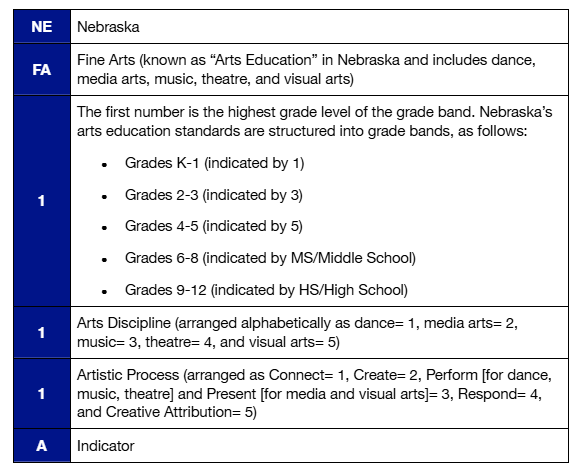
Nebraska’s standards reflect the tiered structure common across all content areas. Grade-level or grade-band standards include broad, overarching content-based statements that describe the basic cognitive or affective expectations of student learning. They also reflect, across all grade levels, the long-term goals for learning associated with college- and career-readiness. Nebraska’s Arts Education Standards are organized in grade bands of K-1, 2-3, 4-5, 6-8 and 9-12.
Indicators further describe what students must know and be able to do to meet the standard as well as provide guidance related to classroom instruction.
Nebraska’s standards are organized into three levels of specificity:
- K-12 Content Strands. Strands are broad categories that are not specific to a grade level or grade band. They reflect major topics in a subject area. The arts education strands are the four Artistic Processes—Connect, Create, Perform or Present, and Respond— and comprise the four “big ideas” of comprehensive arts education. A fifth Artistic Process, Creative Attribution, has been added to address the ethical use of artistic ideas as inspiration.
- Standards. Standards are statements that describe grade-level expectations, or what students should know and be able to do by the end of each grade level or grade band. They are content-based benchmarks that define basic cognitive, affective, or psychomotor expectations.
- Indicators. Each broad content standard is accompanied by a set of one or more indicators. Indicators further describe what a student must know and be able to do to meet a given standard. They are more specific than standards and delineate expectations between grade levels or grade bands. Curricular indicators are performance-based statements that give educators a clearer understanding of the expected level of student learning.
Nebraska’s Content Area Standards Implementation Framework helps school districts implement the standards by providing examples that may be included in a locally determined curriculum.
Arts Standards Coding
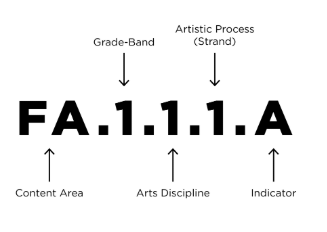
The standards are organized using a coding system that includes the state, content area, grade-band, arts discipline, artistic process, and indicator. The following is an explanation of coding used in Nebraska’s Arts Education Standards.
NE.FA.1.1.1.A
(Nebraska | Arts Education | Grades K-1 | Arts Discipline: Dance | Artistic Process: Connect | Indicator A).
2014 Standards and Glossaries
2014 Standards – Horizontal Views
- Media Arts (pdf) Media Arts (doc)
- Visual Arts (pdf) Visual Arts (doc)
- Dance (pdf) Dance (doc)
- Music (pdf) Music (doc)
- Theatre (pdf) Theatre (doc)
2014 Standards – Vertical Views:
- K-2 Standards (pdf)
- 3-5 Standards (pdf)
- 6-8 Standards (pdf)
- 9-12 Standards (pdf)
Glossaries
To assist in reading the standards, glossaries for each content area contain definitions, explanations, and additional resources you may find helpful.
The Nebraska content area standards describe the knowledge and skills that students should learn, but they do not prescribe particular curriculum, lessons, teaching techniques, or activities. Standards describe what student are expected to know and be able to do, while the local curriculum describes how teachers will help students master the standards. Decisions about curriculum and instructional are made locally by individual school districts and classroom teachers. The Nebraska Department of Education does not mandate the curriculum used within a local school.
Nebraska’s Fine Arts Standards are for grades K-12. For early childhood, visit the Early Learning Guidelines for Nebraska’s Birth to Age Five Learning and Development Standards and refer to the Creative Arts section which includes information for the areas of music, visual art, dramatic play, and movement.