





Digital Resources

Digital resources are always changing and being updated. Look through the resources found on this page and come back and visit them often as digital nuances come up new resources are added or come available throughout the year.
The Nebraska Department of Education School Safety & Security Team will be adding additional digital presentations for any instructor to learn and present themselves. The Digital Parent Academy is already available on our YouTube Channel in a four-part series. If you are seeking a digital presentation, you say presented by the School Safety Team, just email a Team member to see if you can get a copy of the presentation to share with your school community. Also, many of the resources found on this page are items school personnel can use to develop digital guidance to support your school community in building a better digital culture and climate.
The NDE School Safety & Security Bullying and Cyberbullying pages have lots of resources, links, and videos for teachers, school districts, parents and students.
Teach Students GenAI First
Using GenAI With Guidance & Support, Not Guesswork
Students were effectively thrown into the digital landscape of social media without guidance, training, or ethical frameworks. As a result, they learned platform norms through trial and error—often encountering harm, misinformation, and unhealthy habits along the way.
We cannot afford to repeat that mistake with Generative AI.
Unlike social media, GenAI is not just a communication tool—it is a decision-making partner, content generator, and cognitive amplifier. Without structured education, students may either misuse it, over-rely on it, or fail to understand its limitations.
Providing students with intentional instruction on the benefits, risks, and appropriate use of GenAI leads to better outcomes in two important ways:
- Reduced Misuse Through Awareness
Students who understand issues like hallucinations, bias, privacy risks, and academic integrity are less likely to use GenAI irresponsibly or blindly. - More Purposeful and Strategic Use
Rather than using AI randomly or aimlessly, informed students can:- Ask better questions
- Evaluate outputs critically
- Use AI to enhance—not replace—thinking
- Apply it deliberately toward learning goals
The goal is not to discourage use, but to shift from passive consumption to intentional engagement.
AI for Education has provided a free course for students and resources to aid educators.
- GenAI Literacy 101 for High School Students Course
- Students Enroll NOW in the Online FREE Self-paced Course
- Staff can SEE Framework for Generative AI Literacy – Knowledge of How GenAI Works, Mindset of GenAI Use, and the Safe, Ethical, & Effective Practices
- More information is available on AI for Education
Age matters when introducing any digital content. The illustration of age appropriate instruction for digital content comes from AI for Education’s recommendations:

Educate Students on How Their Privacy is Lost on Digital Platforms
Privacy Lost in "Terms of Service" We Didn't Read
Although privacy is important, most users habitually click “Accept” on Terms of Service without reviewing them. This behavior:
- Grants companies permission to collect large amounts of personal data
- Allows tracking of user activity, preferences, and behavior
- Enables companies to monetize user data through targeted ads and engagement strategies
In effect, users often unknowingly trade privacy for convenience and access.
Utilize this site to aid students in understanding how they so easily relinquish their privacy.
- Terms of Service – Didn’t Read site utilizes a grading system of the privacy lost by accepting their ‘terms’:
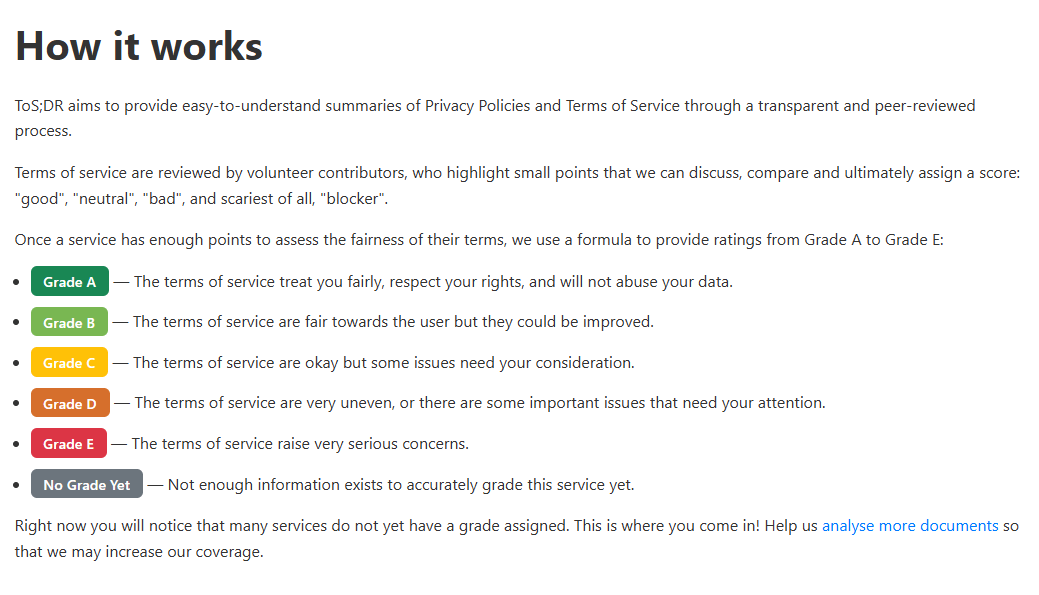
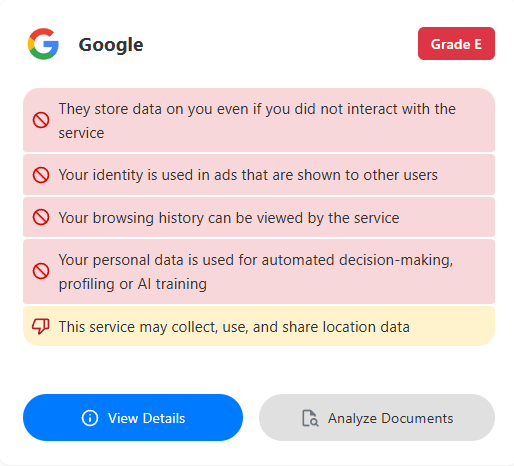
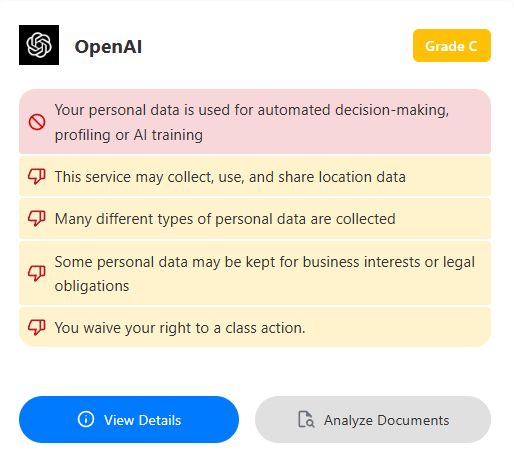
- A cliff notes version of the “Terms of Service“, with the digital platform’s pros and cons, its grade, along with the ability to view details and/or analyze documents is provided for each individual platform (see examples):
Students who recognize that their time is a valuable resource—and that it is often consumed by platforms using privacy-invasive tactics—begin to limit their digital use. As a result, they become more intentional and purposeful in how they engage online, leading to improved overall well-being.
A.I. Chat Bots Issues with Engagement Priorities Over Child's Safety on a 60 Minutes Episode
Character AI pushes dangerous content to kids, parents and researchers say | 60 Minutes
Below is a portion of the full news story that can be found on 60 Minutes website from the January 2026 news clip.
Editor’s Note 1/8/26: Character AI and Google have agreed to settle several lawsuits with families who say their teens died by suicide or harmed themselves after interacting with the tech platform’s chatbots.
In December, 60 Minutes reported on Character AI, speaking with parents who told us the Character AI bots their 13-year-old daughter interacted with failed to adequately address her pleas for help, and often behaved like a digital predator.
Part of modern parenting, for many of us, is navigating the shifting landscape of digital threats. From the pitfalls of social media to the risks of excessive screen time.
Now, a new technology has quietly entered the homes of millions, AI chatbots — computer programs designed to simulate human conversations through text or voice commands.
One popular platform is called “Character AI.” More than 20 million monthly users mingle with hyper-realistic, digital companions through its app or website…
…Juliana’s parents are now one of at least six families suing Character AI, and its co-founders Daniel De Freitas and Noam Shazeer. During a 2023 podcast, Shazeer said chatbots would be beneficial.
Noam Shazeer: It’s going to be super super helpful to like a lot of people who are lonely or depressed.
Shazeer and De Freitas were engineers at Google when executives deemed their chatbot prototype unsafe for public release. They both left the company in 2021 and launched Character AI the following year.
Noam Shazeer: I want to push this technology ahead fast, like that’s what I want to go with because it’s ready for an explosion like right now. Not like in like five years when we solve all the problems.
A former Google employee told 60 Minutes that Shazeer and De Freitas were aware their initial chatbot technology was potentially dangerous.
The employee, familiar with Google’s ‘Responsible AI group’ that oversees ethics and safety, said of the lawsuits: “This is the harm we were trying to prevent. It is horrifying”
Last year, in an unusual move, Google struck a $2.7 billion licensing deal with Character AI, they didn’t buy the company but have the right to use its technology.
The deal also brought founders Shazeer and De Freitas back to Google to work on AI projects.
In September, parents of children who died by suicide after interacting with chatbots testified before Congress.
Megan Garcia is among those suing Character AI.
She says her 14-year-old son, Sewell was encouraged to kill himself after long conversations with a bot based on a “Game of Thrones” character.
Megan Garica in Senate hearing: These companies knew exactly what they were doing. They designed chatbots to blur the lines between human and machine, they designed them to keep children online at all costs.
…In October, we met Shelby Knox and Amanda Kloer. They’re researchers at Parents Together, a nonprofit that advocates for families…
Produced by Ashley Velie. Associate producer, Eliza Costas. Broadcast associate, Erin DuCharme. Edited by Peter M. Berman.
2025 Digital Webinar - Good, Bad, & Ugly of Social Media
Webinar with Four Corners Health Department
Social Media Influences: The Good, Bad, and Ugly
Recommended Digital Reads

Dr. Haidt's Overview Discussion on His Book
Variety of Digital Resources

Children and Screens address today’s most compelling questions about media’s impact on child development through interdisciplinary dialogue, objectives, scientific research, and information sharing. There are several Topics, Ages and Stages (all ages), Formats (to getting answers).
 Topics included:
Common Sense where most technology wasn’t built with kids in mind. We’re on a mission to change that. There are a variety of resources available including curriculum, lessons, toolkits, student games, tips, professional development, and family resources too. Parents resources include movie, tv and book reviews, Apps & games reviews, podcasts and parent guides.

Be Internet Awesome by Google educates students and children to make the most of the Internet while staying safe. They share a variety of free resources for parents/families as well as critical information regarding digital citizenship. It is also an interactive tool that helps student’s complete activities to practice being safe on the Internet. It is a great resource for families, educators, and students. Including slides for presentations in the classroom!
 CyberCivics Included curriculum, The book, Teachers/Parents Resources, Blogs, and a Store. Teach your student how to become ethical, safe, and productive digital citizens with our comprehensive digital literacy curriculum for grades 4-8.
Dynamic, teacher-led lessons are standards-aligned and CIPA compliant. Designed in the classroom by actual teachers. Loved by homeschoolers too.

SmartSocial helps parents understand tech & social media to keep kids safe & successful! There are hundreds of resources available – blogs, teen slang being used and their #hashtags, popular teen Apps, video games, and parental controls available, as well as a human trafficking guide. There are other programs for parents and students.
They have a variety of videos available on YouTube as well…check them out by typing in SmartSocial.
 Conversations that click. The Smart Talk is a free tool that helps families set digital ground rules together.
The Smart Talk helps children and families feel safer and more empowered in their digital lives. National PTA and Norton co-created The Smart Talk in 2015 and completed a major expansion and redesign in 2022.
 ReThink an App to combat cyberbullying developed by a student features free resources. One such resource is an application that students can put on their phones or tablets to help them think twice before engaging in bullying behavior before hitting the send button. From a psychological point of view, it helps with impulse control, allowing students to engage in de-escalation activities before engaging in cyberbullying. It is a free resource for students and schools.
 Center for Safe Schools offers a comprehensive Bullying & Cyberbullying Prevention Toolkits to help educators, parents, and students better understand and prevent bullying behaviors. The toolkit includes valuable resources such as strategies for intervention, training materials, and actionable steps to foster a culture of respect and inclusion in schools.

KnowBe4 will strengthen your security culture. You can get a personalized demo on the human risk management platform in action. It contains a variety of security awareness tools and trainings. Cloud, AI, Security and phishing trainings and tools along with many other resources to protect end users.