
Strategic Plan
Nebraska Department of Education ‘Good Life, Great Schools, Excellent Education’ logo
On December 5, 2025, the Nebraska State Board of Education unanimously approved the 2025-2030 Strategic Plan. This plan went into effect January 1, 2026.
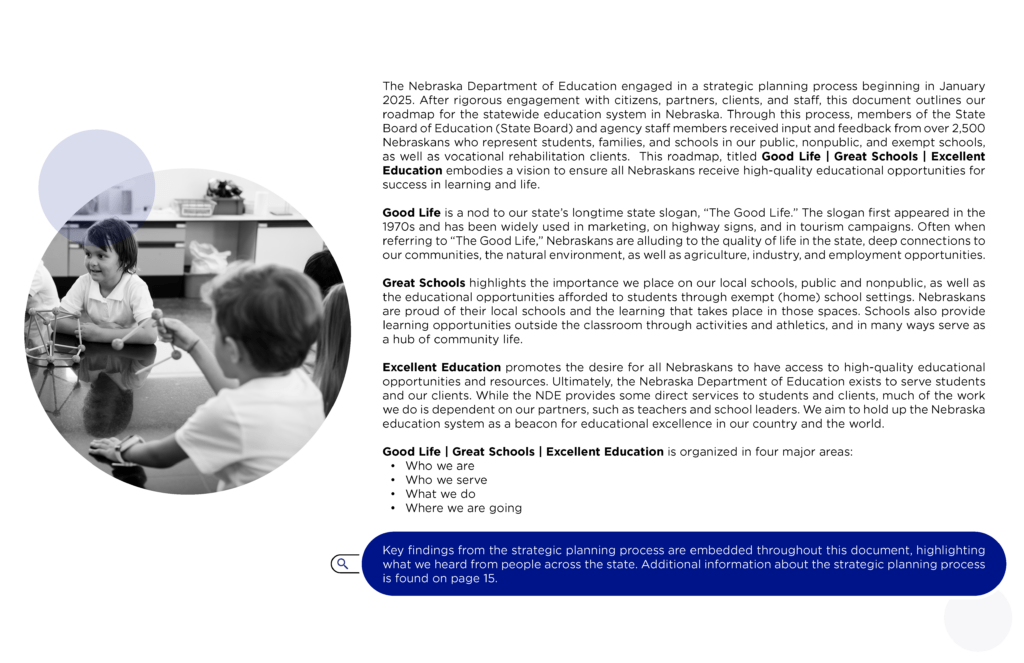




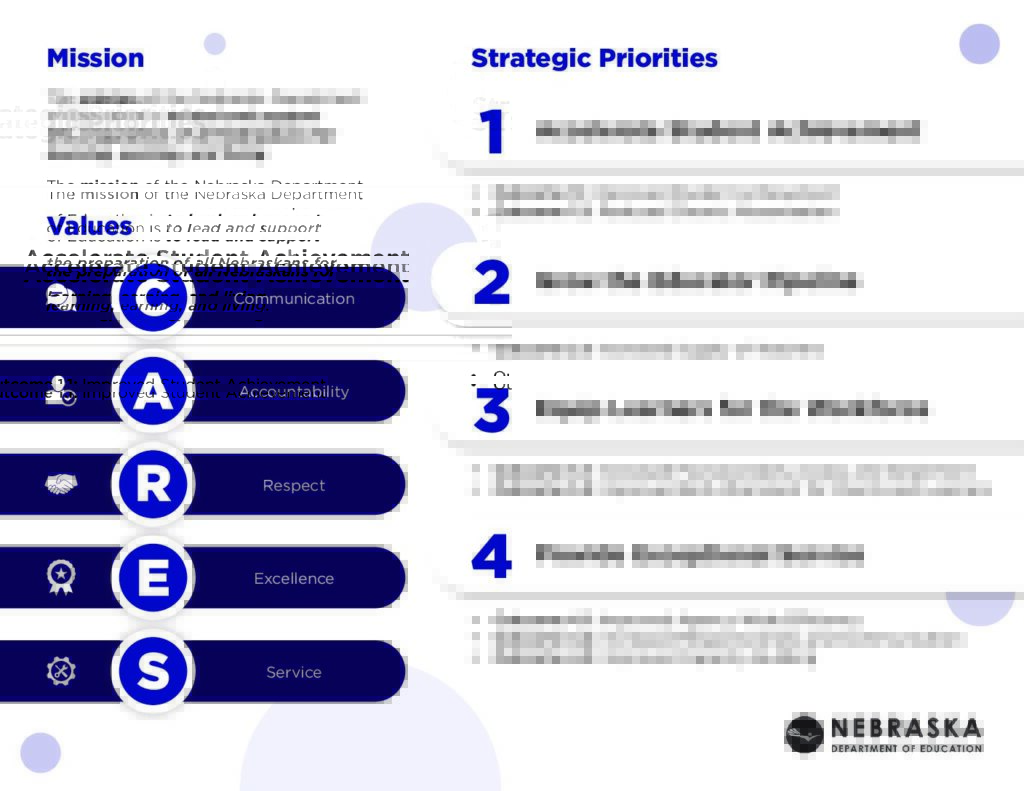
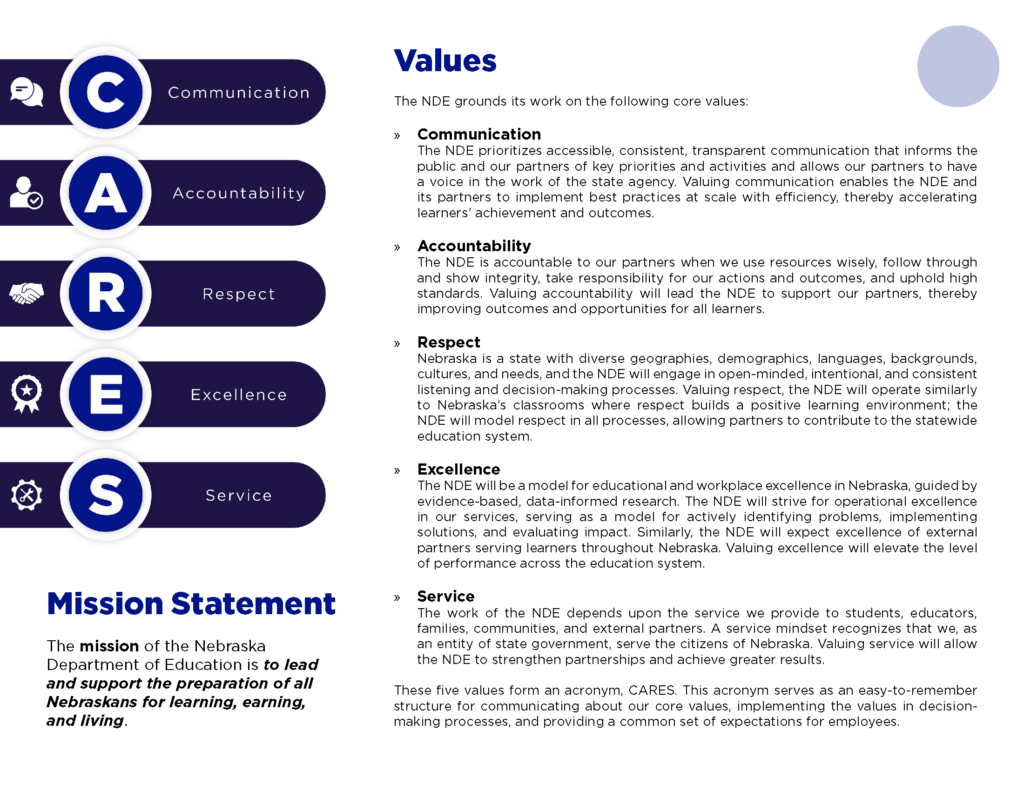
The mission of the Nebraska Department of Education is to lead and support the preparation of all Nebraskans for learning, earning, and living.
The NDE grounds its work on the following core values:
- Communication: The NDE prioritizes accessible, consistent, transparent communication that informs the public and our partners of key priorities and activities and allows our partners to have a voice in the work of the state agency. Valuing communication enables the NDE and its partners to implement best practices at scale with efficiency, thereby accelerating learners’ achievement and outcomes.
- Accountability: The NDE is accountable to our partners when we use resources wisely, follow through and show integrity, take responsibility for our actions and outcomes, and uphold high standards. Valuing accountability will lead the NDE to support our partners, thereby improving outcomes and opportunities for all learners.
- Respect: Nebraska is a state with diverse geographies, demographics, languages, backgrounds, cultures, and needs, and the NDE will engage in open-minded, intentional, and consistent listening and decision-making processes. Valuing respect, the NDE will operate similarly to Nebraska’s classrooms where respect builds a positive learning environment; the NDE will model respect in all processes, allowing partners to contribute to the statewide education system.
- Excellence: The NDE will be a model for educational and workplace excellence in Nebraska, guided by evidence-based, data-informed research. The NDE will strive for operational excellence in our services, serving as a model for actively identifying problems, implementing solutions, and evaluating impact. Similarly, the NDE will expect excellence of external partners serving learners throughout Nebraska. Valuing excellence will elevate the level of performance across the education system.
- Service: The work of the NDE depends upon the service we provide to students, educators, families, communities, and external partners. A service mindset recognizes that we, as an entity of state government, serve the citizens of Nebraska. Valuing service will allow the NDE to strengthen partnerships and achieve greater results.
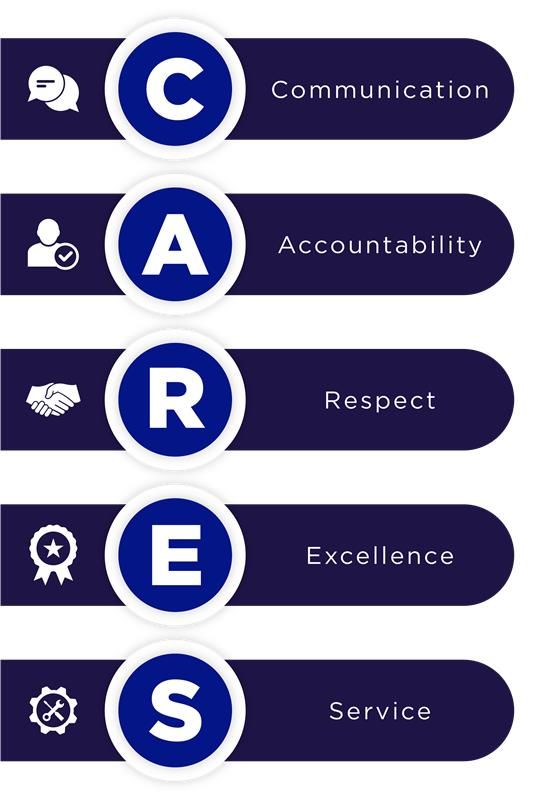
NDE CARES graphic
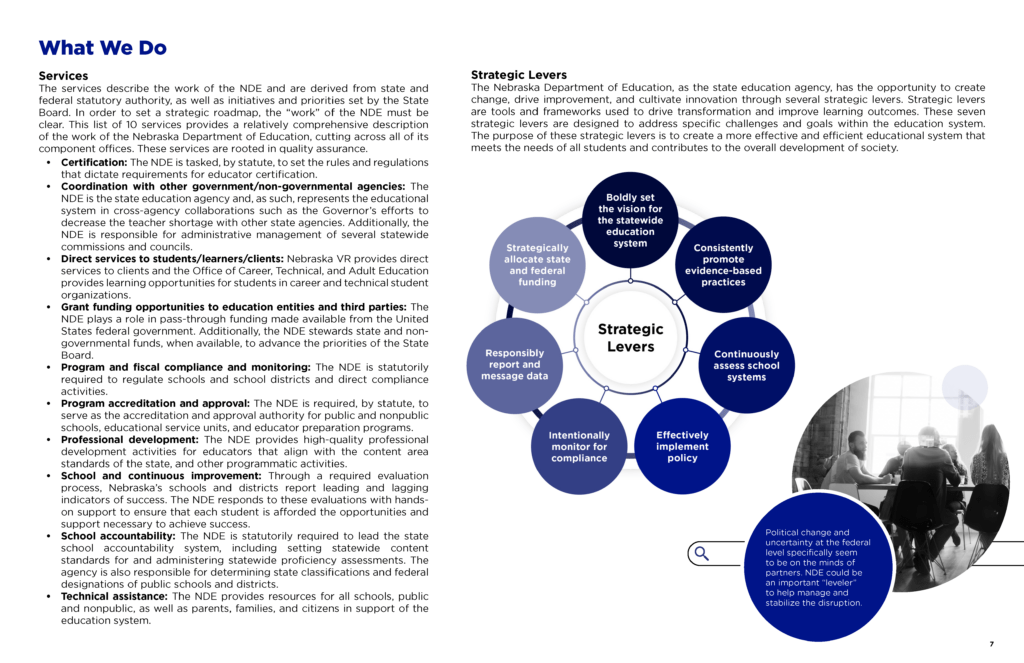
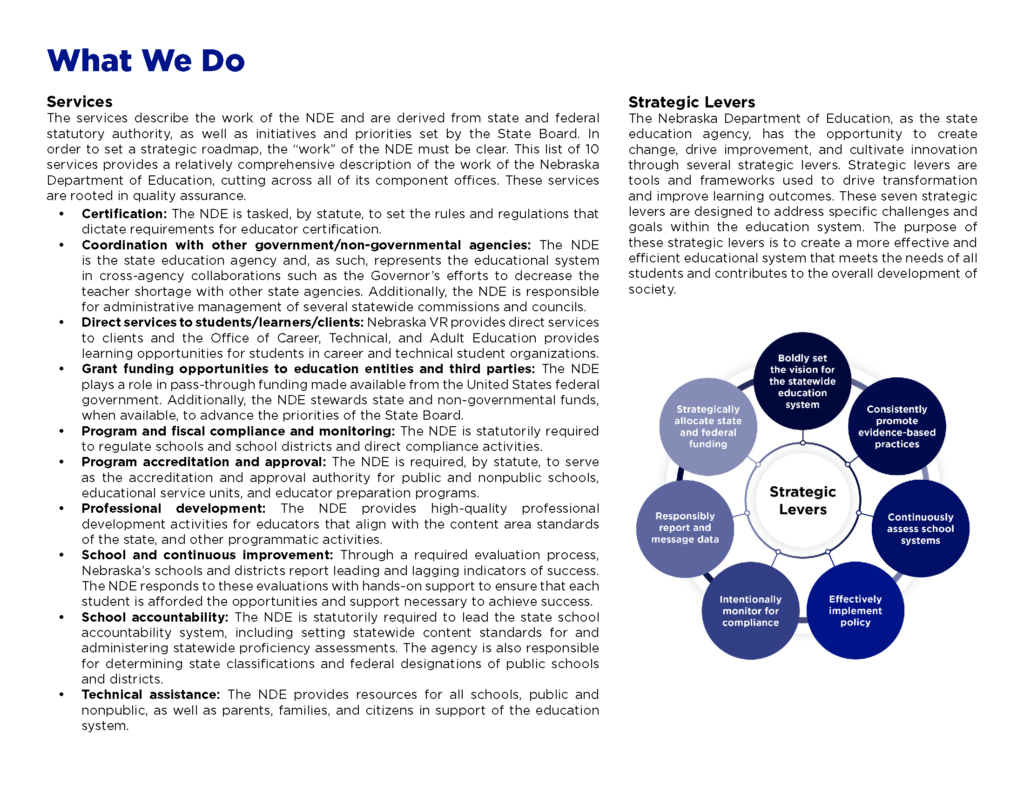
The Nebraska Department of Education, as the state education agency, has the opportunity to create change, drive improvement, and cultivate innovation through several strategic levers. Strategic Levers are tools and frameworks used to drive transformation and improve learning outcomes. These seven strategic levers are designed to address specific challenges and goals within the education system. The purpose of these strategic levers is to create a more effective and efficient educational system that meets the needs of all students and contributes to the overall development of society.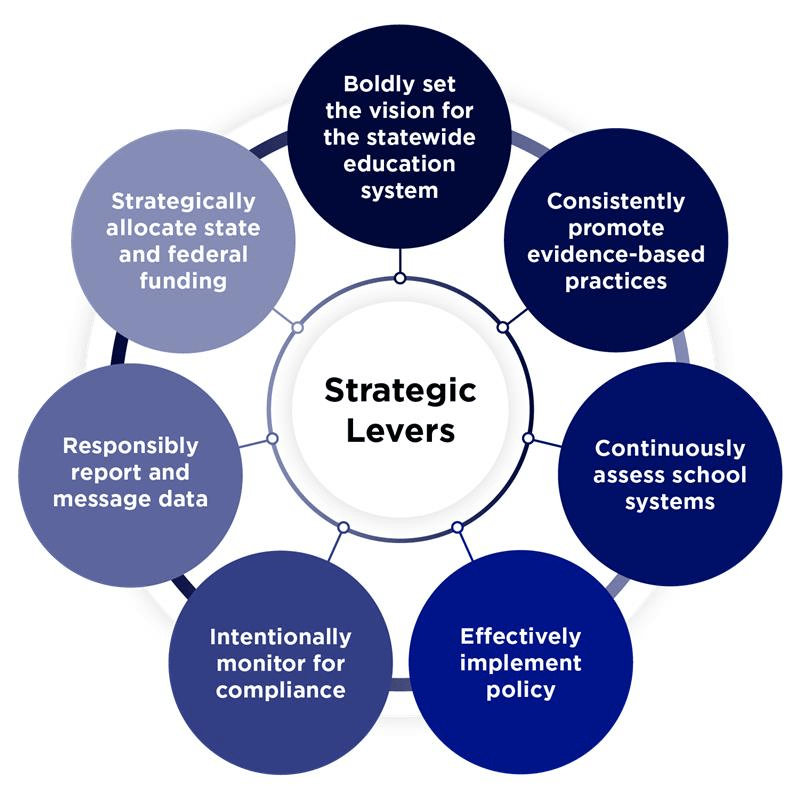
Students and clients thrive when they are met with high expectations and gain the knowledge, skills, and mindsets to engage and contribute to their communities. While all content areas are important to prepare students, the NDE will focus this plan on English language arts (ELA) and mathematics, recognizing the immediate achievement needs of students in these two areas.
Achieving this priority and outcomes will only be possible when the NDE focuses specific attention on improvement within student groups. The identified student groups are those reported in the ESSA plan.
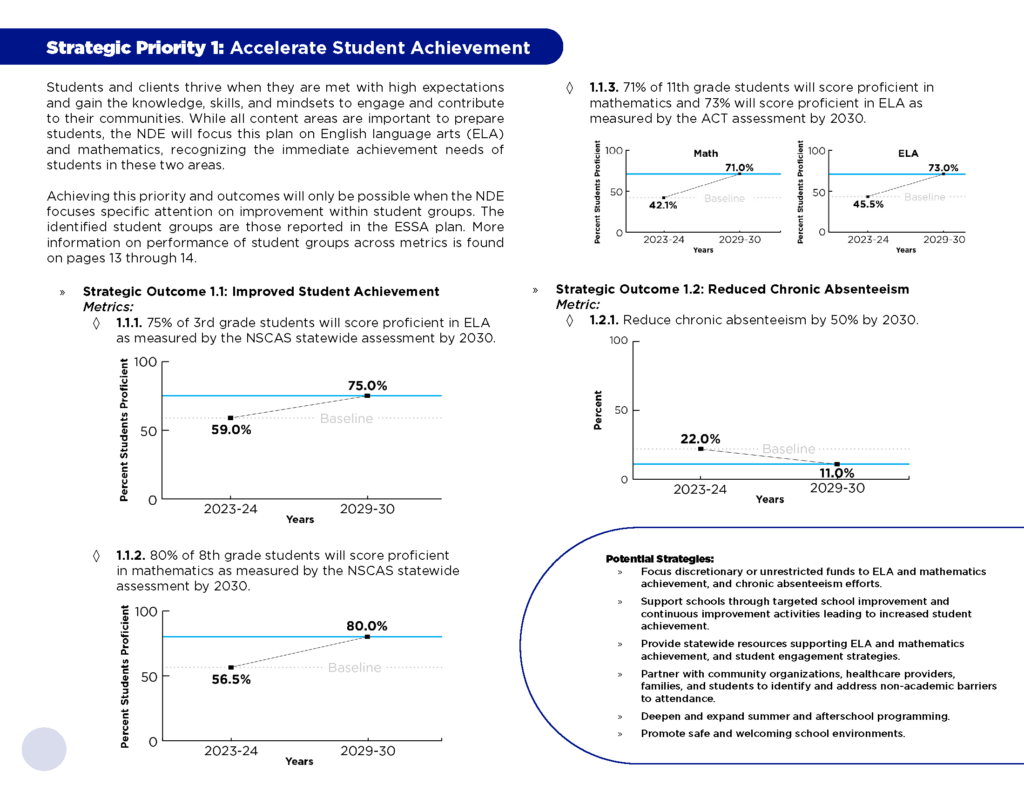
Strategic Outcome 1.1: Improved Student Achievement
Metrics:
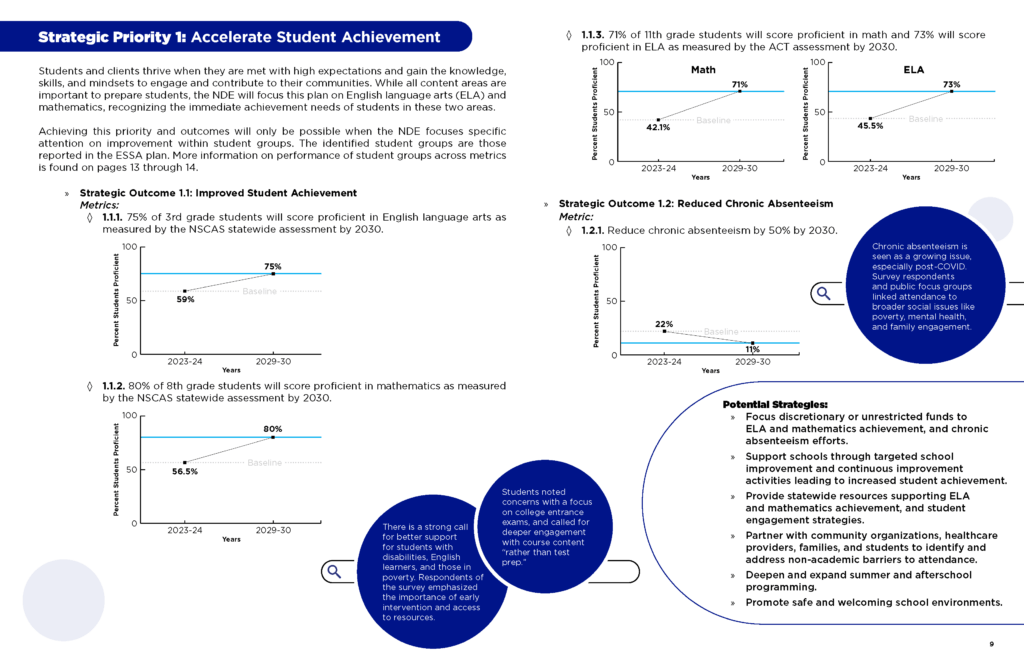
- 75% of 3rd grade students will score proficient in ELA as measured by the NSCAS statewide assessment by 2030.
- 80% of 8th grade students will score proficient in mathematics as measured by the NSCAS statewide assessment by 2030.
- 71% of 11th grade students will score proficient in mathematics and 73% will score proficient in ELA as measured by the ACT assessment by 2030.
Strategic Outcome 1.2: Reduced Chronic Absenteeism
Metric:
- Reduce chronic absenteeism by 50% by 2030.
The single most important in-school factor associated with student achievement is the quality of the educator a student engages with daily. Every child deserves access to high-quality educators, supported by high-quality leaders and support staff. (NOTE: The NDE recognizes the importance of all educators and school personnel; this plan focuses squarely on teachers, recognizing the current classroom teacher needs in the state.)
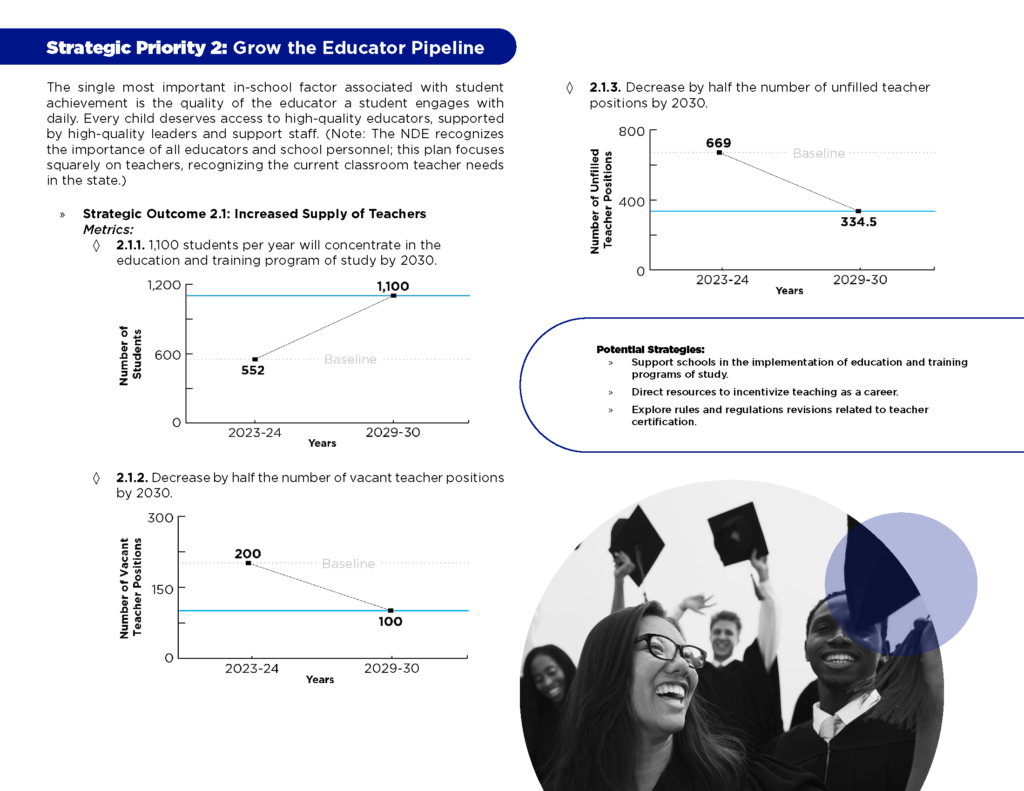
Strategic Outcome 2.1: Increased Supply of Teachers
Metrics:
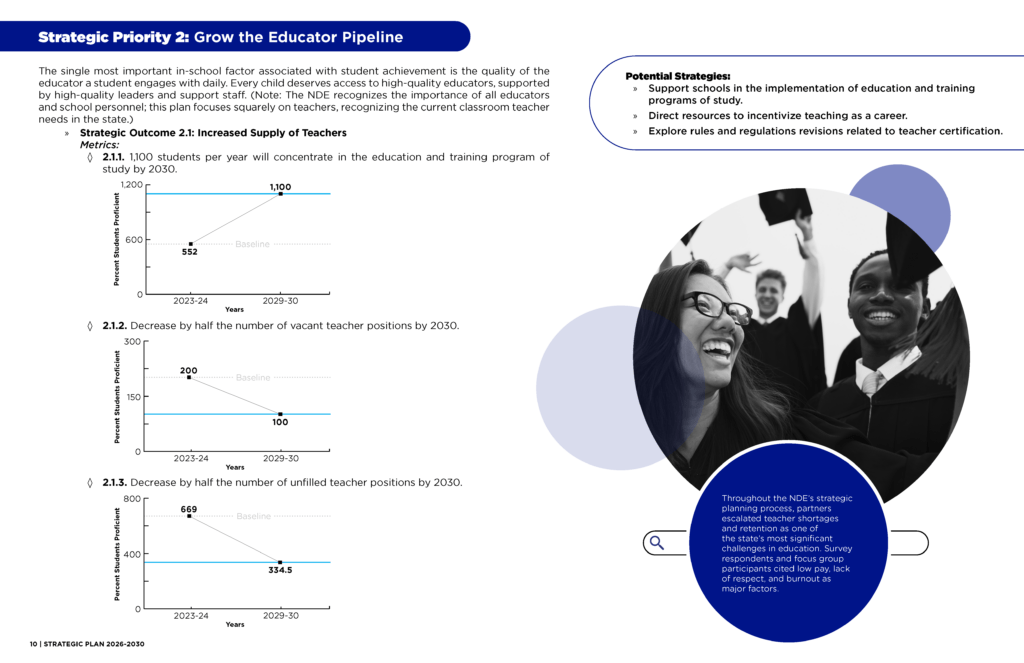
- 1,100 students per year will concentrate in the education and training program of study by 2030.
- Decrease by half the number of vacant teacher positions by 2030.
- Decrease by half the number of unfilled teacher positions by 2030.
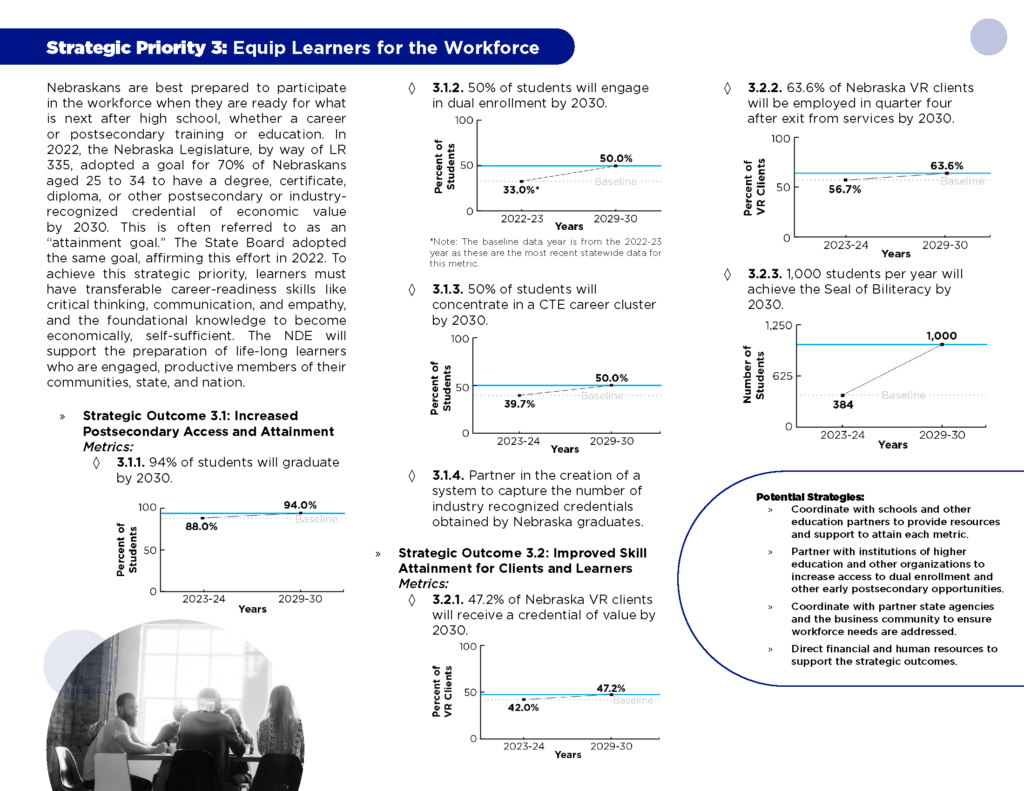
Nebraskans are best prepared to participate in the workforce when they are ready for what is next after high school, whether a career or postsecondary training or education. In 2022, the Nebraska Legislature, by way of LR 335, adopted a goal for 70% of Nebraskans aged 25 through 34 to have a dree, certificate, diploma, or other postsecondary or industry-recognized credential of economic value by 2030. This is often referred to as an “attainment goal.” The State Board adopted the same goal, affirming this effort in 2022. To achieve this strategic priority, learners must have transferable career-readiness skills like critical thinking, communication, and empathy, and the foundational knowledge to become economically, self-sufficient. The NDE will support the preparation of life-long learners who are engaged, productive members of their communities, state, and nation.
Strategic Outcome 3.1: Increased Postsecondary Access and Attainment
Metrics:
- 94% of students will graduate by 2030.
- 50% of students will engage in dual enrollment by 2030.
- 50% of students will concentrate in a CTE career cluster by 2030.
Strategic Outcome 3.2: Improved Skill Attainment for Clients and Learners
Metrics:
- 42.7% of Nebraska VR clients will receive a credential of value by 2030.
- 63.6% of Nebraska VR clients will be employed in quarter four after exit from services by 2030.
- 1,000 students per year will achieve the seal of biliteracy by 2030.
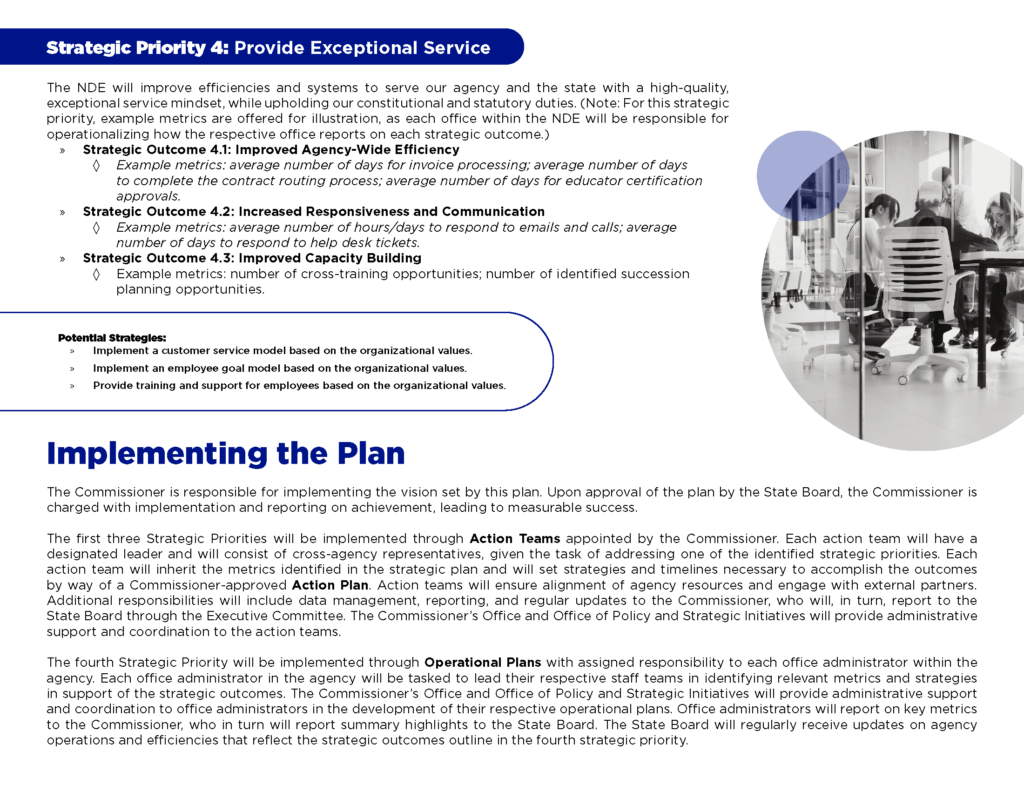
The NDE will improve efficiencies and systems to serve our agency and the state with a high-quality, exceptional service mindset, while upholding our constitutional and statutory duties.
Strategic Outcome 4.1: Improved Agency-Wide Efficiency
Strategic Outcome 4.2: Increased Responsiveness and Communication
Strategic Outcome 4.3: Improved Capacity Building